Missouri State Archives
Camp Crowder Collection
View the CollectionSearch the Collection
Introduction
Camp Crowder was a military installation in Newton and McDonald Counties named in honor of Major General Enoch H. Crowder, Provost Marshal of the United States during World War I and author of the 1917 Selective Service Act. The camp, located near Neosho, Missouri, was established in 1941. By 1942, the first soldiers arrived at the Signal Corps Replacement Training Center and were trained in 40 different military communications specialties involving radio, radar and telephone operation and maintenance. In addition to the signal corps training, the post trained medical corps soldiers and ground force troops. Camp Crowder also included an Officer Candidate Preparatory School, the first school of its kind in any Army installation. The camp had a bakery, ordnance motor repair shops, a large laundry and warehouses for supplies. Barracks were segregated. During World War II, a large 2,000-capacity prisoner of war camp existed within the greater Camp Crowder. The mostly German POWs worked within the larger camp, learning trade skills such as butchering, auto mechanics, baking and laundering.
At its peak, Camp Crowder covered over 42,000 acres and housed up to 47,000 soldiers. The grounds included six movie theaters, 16 chapels, one hospital, 15 smaller infirmaries, three dental clinics, a field house, 22 branch sites of the Post Exchange, three beauty parlors, many training facilities and more. Staff published a newspaper Camp Crowder Message (later The Message) with a circulation of 15,000. In addition to American soldiers and foreign POWs, Camp Crowder also housed Women’s Army Corps (WAC) personnel and American Red Cross offices.
Famous alumni include comedian/writer/producer Carl Reiner, Beetle Bailey cartoonist Mort Walker and entertainer Danny Talkov. After training tens of thousands of soldiers for World War II and employing thousands of civilians, Camp Crowder was deactivated on Jan. 13, 1947.
In the early 1950s, U.S. Representative Dewey Short successfully lobbied to re-open the facility, this time as a disciplinary barracks. Fort Crowder U.S. Disciplinary Barracks (USDB) received its first military prisoners on Aug. 4, 1953. Col. Herman H. Reed served as the first Commandant. The USDB had a capacity of 1,500 prisoners who were trained in various vocations, such as furniture upholstering, auto mechanics, shoe repair, leatherworking, graphic arts, sheet metal work and farming. The USDB closed on Jan. 31, 1958.
In 1956, part of the former Camp Crowder was sectioned off and transferred to the United States Air Force as Air Force Plant No. 65. From 1957-1973, the Air Force tested rocket engines at the Rocketdyne-run site, including rockets used in the Mercury and Gemini Space Programs. The site was sectioned into the Manufacturing Plant Area, the Components Test Area, the Engine Test Area and the Quince Road Area. The Test Areas were sold individually to private firms over time.
Other parts of the grounds formerly belonging to Camp Crowder and Fort Crowder USDB were sold and a public community college called Crowder College opened its doors in its stead in 1963, which is still in operation. The remainder of the land now belongs to the Missouri National Guard.
The Collection
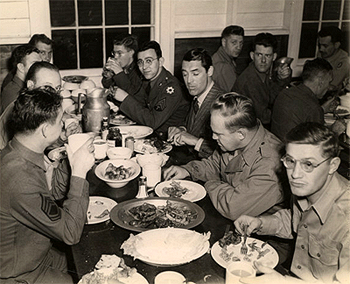
The Camp Crowder Collection includes 392 photographs and 81 corresponding newspaper clippings from its days as a World War II camp (1941-1946). There are many items from Staff Sergeant Danny Talkov, a comedian who performed under the stage name Danny Tucker and entertained an estimated 500,000 troops and guests during his time at the Camp. Researchers will find a few publications and documents in this collection as well. The collection also includes a photograph album of the later Fort Crowder USDB, dated c1955-1957, which contains 119 individual photographs. The album was compiled by Master Sergeant and USDB Classification Officer Harold Francis Hewson (1920-1999) and donated to the Archives in 2020 by his granddaughter. Its leather cover was fashioned by the USDB military prisoners.
Rights and Reproductions
All images are in the public domain and may be reproduced with the proper citation.
[image name]; "[Description]," [date]; [photographer]; MS262 Camp Crowder Collection, Record Group 998, Missouri State Archives, Jefferson City.
For example:
MS262_067_009.tif; "Movie star Cary Grant...," March 1943; unknown photographer; MS262 Camp Crowder Collection, Record Group 998, Missouri State Archives, Jefferson City.
Contact the Archives with questions at [email protected] or (573) 751-3280.
Additional Resources
At the Missouri State Archives:
Finding aid to MS262 Camp Crowder Collection is online here.
RG101 Office of Administration
RG953 U.S. Works Project Administration